Monday, May 21, 2012

Mountain Sickness Article Summary

The dream of achieving the extreme  has always appeal to the human race. But extremes are things such as flying, bungee jumping and most importantly summiting large mountains like Everest.
Like any type of extreme summiting mountains do have their set backs. Dangerous things like losing amounts of oxygen, frost bite and "mountain sickness".

The earliest known written account was taken in the first few decades of the first century A.D. The account was written by a general in the time of Emperor Wudi of the Han Dynasty. The general wrote about the sever headaches that people experienced. In this time people were not lured to mountain climbing because of the thrill but because of military campaigns and most importantly hunting and trade.

During the years of 602-664 A.D, the worlds "first mountaineer" Xang Zang, wrote of his travels to the high mountains. Dr.Houston uncovered these writing and found and outstanding remarks. Intrestingly enough Xang Zang referred to the cold, harsh weather and mountain sickness as a fierce dragon. Because of this belief people were advised never to wear red garments and if these rules were in the slightest way violated, disaster would happen.

In more recent times, a spanish Jesuit priest(Jose de Costa) in Peru during1590, wrote of the ill effects that he observed to his companions in a high mountain pass in the Andes. He wrote of the harsh coughing and the green and yellow mucus that was spit up along with blood.

Later on 1850 the "full swing of flying was in act". This lead to ballooning. In 1862 a hot air balloon manned by Sir James Glaisher and a companion flew about to the highest mountain in the world, Mt. Everest. The written account by Glaisher describes in detail about his experience, up until the point where he became unconscious. He wrote about how his arms started to feel heavy and unable to move and his world was spinning.

In 1875 humans realized that the higher altitude the harder it is to breath. So people started to test their capabilities. One of these tests included people testing their abilities to withstand higher altitude.

In 1891 what I believe as a breakthrough arose. On september 2, 1891 author Dr. Houston wrote about a tragic day in the Mont Blanc Mts. "a young French physician lay desperately ill high on Mont Blanc. He had hurried up from the village of Chamonix to help build a new observatory. The next day he climbed to the summit(4,800 meters), and within 24 -hours wrote to his brother that, due to mountain sickness, he had never passed so terrible night. He died three days after arrival, a victim of altitude, and was called 'a martyr to science.' His is the first well-documented case of high altitude pulmonary edema" 

Tuesday, May 15, 2012

"Faceless" Indus Valley Article Summary

 Almost a century ago in 1921 the Indus Valley civilization was found revealing 2 very important cities, Harappa and Mohenjo-Daro.

Mohenjo-Daro along with Harappa show obvious signs of a well planned city. The streets are made of street grids also these cities have clay drainage systems. What archaeologist are trying to discover is the puzzling question who lived in these systems. Who had this type of sophisticated life.

Mohenjo-Daro is also known as the faceless city. Nothing in Mohenjo-Daro gives archaeologists clues or any type of information of the religion or how government. No plalaces, temples or monuments have been found neither any evidence or a monarchy without monarchy Mohenjo- Daro was most likely governed as a city state.   Pottery and tools were standardized, signs of trade are apparent, seals and weights have been dug up from the mysterious city.


Mohenjo-Daro is mostly made of mounds, a Great Bathing place is the tallest mound and probably the closest thing to a temple for Mohenjo-Daro. Archaeologist, Jonathan Mark Kenoyer from the University of Wisconsin , Madison,  also a National Geographic grantee, states that "the mounds grew organically over the centuries as people kept building platforms and walls for their houses." One of the great artifacts that made the archaeologists of the excavation jump with joy is a small bronze nude female statue(the dancing girl discovered in 1926. What amazed Kenoyer even more were a few stone male sculptures with men seated. One man seated is named the Priest Kind even though no evidence has been found of a priest or king.

Archaeologist are clueless to what ended these thriving civilization. There is no evidence that yearly flooding destroyed the city and was it already abandoned by the time the city was destroyed.

Wednesday, February 8, 2012

Enheduana of Sumer from Outrageous Women of Ancient Times

Leon, Vicki. "Enheduana of Sumer." Outrageous Women of Ancient Times: 49-53. Print.
4,300 years ago lived beautiful Enheduana, the daughter of the greatest of all Akkadian kings, Sargon.
 Sargon ruled from 2334-2279 B.C. Enheduana had two twin brother Rimush and Manishtusu, all four lived in a new palace in the city-state of Akkad in Sumer(Where Bagdad is today). Sargon was the son of a family and farmers, but he had drive and talent to be king. He started out as a cup bearer and went to the top to be king. Enheduana, much like her father(Sargon) she had drive and talent much like her father and unlike like her brothers, since her brothers did not have the talent Sargon assigned her as high priestess of Nanna giving her the ability as royalty to learn how to write and read. 


Enheduana to lots of pride in her writing, she had written a set of 42 poems and other stories and writings. She put a lot of her religious beliefs into her writings. Enheduana didn't write on paper like we do today instead she wrote on clay tablets. She was also the only known writer to include her own name in her writings. Enheduana was the bestseller of her time, when i say best seller i don't mean people bought her writings. In this time writings weren't bought they were just copied down. Archaeologist now this because they had found over 50 copied writings of hers by other writers.  Her writings were special because they gave us a lot of information of her time period and herself. 

After her father died her brother Rimishu went into power and then her other brother Midishu. Both brothers were very ignorant and loved bloodshed so they were killed by enemies who had a lot of hatred for them. Since the two were dead a nephew of Enheduana came into power, the evil nephew kicked Enheduana out of her potion and awarded it to his own daughter and possibly threw Enheduana to the treacherous desert. Enheduana in the end in my opinion won the fight between her and him, because nobody remembers her bull headed nephew while Enheduana will be remembered for centuries due to her amazing writings.

Tuesday, February 7, 2012

Reflection on Cuneiform

Reflection on Cuneiform Writing Activity:
When we had first started the activity thought that writing cuneiform would be a piece of cake, i was wrong. Cuneiform for me at least was a bit difficult to write , especially getting the shapes and length of the triangles write. Like the English language the shape of the letter can change what people interpret the letter to be, so the shape obviously matters to get your message across. One thing that interested me is that all of the letters are arrangements of triangles unlike our language, all of the letters are different shapes so it is easy distinguish when there is a new word.
The Cuneiform triangles pointed in different directions ,were different lengths and sometimes were the same length and direction but just had a different amount of triangles symbolizing a different letter. For example a and n. A was 2 small triangles pointing to the right  like this >> except with ends to each of the triangles while N was 3 small triangles like this >>>. The same triangles just 1 more in the letter N symbolizing totally different letters. I paired up with Alex L. to switch our writings. Cuneiform is extremely confusing to read because of the shapes. Alex had written in cuneiform “ Sumerians created these weird symbols”, I didn't even get close i came up with “ Sumerians creater the je symbols”. It was very challenging some of the triangles were perceived to be pointing one way but actually they were pointing the other or there were supposed to be 2 triangles but it looked like one large one.

Sunday, February 5, 2012

Hammurabi's Babylonia From the Babylonians By Elaine Landau


Landau, Elaine. "Hammurabi's Babylonia." The Babylonians: 39-44. Print. 
Hammurabi was the sixth king of the Mesopotamian city state of Babylonia from 
1792 B.C- 1750 B.C. Hamurrabi became the first king of the Babylonian empire when
the first Babylonian  empire evolved. Hammurrabi is known for his creation of the
"Legal Code". This code is simply a bunch of laws that the Babylonians had to 
follow. The complete "Legal code had 280
sections that consisted of laws for herdsmen, farm laborers, stealing or 
destroying property and rates for renting boats, wagons or a farm animal. 
Some sections of the legal code had laws covering marriage, divorce, adoption, 
inheritance and assault.
Other parts were about treatment and sale of slaves as well as unsatisfactory 
services. 
When i read through some of the laws that the article had exemplified I noticed 
that if something was done wrong or poorly someone would have to pay for their 
actions by being assaulted, meaning that they were punished with death of them or
their children, a broken limb, torture, or even a loss of an eye or ear. But in 
contrast I found some of the rules very reasonable and fair.
For example If a flood or drought occurs resulting in crop failure, and someone 
is unable to pay interest debt, he is excused of having to pay that years interest
debt that year. I thought this was very reasonable and fair because a natural 
disaster is not the persons fault and there is nothing he can do about this. So I 
am totally in favor of this law. Another example is that if two people engage in 
a fair fight and one is injured the other who cause the injury may have to pay for 
medical treatment but the one causing the injury cannot be punished any further 
for causing the injury. This is such a smart and fair rule, each one has to 
serve their payment for fighting.
A example for unfair laws is that if someone is helping to steal something from a 
premises that individual may be thrown into the fire. I think this is a little to
harsh but i totally agree that if you caused a crime or help cause a crime you 
should be punished for your doing but i do not think it should result in death. 
I believe that they should only be locked up or do extra work or any other punish
ment that doesn't kill them or intentionally hurt them like cutting body part or 
others. Many of the laws result in an intentional injury or death, most of these 
I disagree with but some do make sense. In cases where a person committed murder 
of higher arc hey i do believe death should be the penalty. 
One rule that i really like is that the women had some right for example is that 
women were allowed to have their own property and their own money. This is nothing
compared to what we have now but back then I believe that this is great privilege
for women.
All in all I think that Hammurabi's legal code does have some fantastic and fair
rules and some that  truly dislike and do not favor in. 

Thursday, January 19, 2012

Blog post: Beginnings of Civilization

The wakanari tribe was just waking up to a orange sky next to a shining blue river, and their families houses. Everyone walked out and streched and the hard working day started. Eveyone had their own special job that thwy were good at either, Farming, being an artisan, building trenches connecting a small canal of water to each trench where the plants were harvested or being a local trader/ the person who sold goods.Of course there was also a tribe leader.

As the only goods seller walked through the arrangements of wood houses, he walked wit his head high and flattening the green grass everywhere. 
Everyone loved this goods trader he was always nice and worked hard. After a minutes of walking he reached his wood shack where his goods were. He sold all types of things, fresh meat, already prepared grain pancakes, berries and the most special thing which was unique about his goods is that he had the only figs in the land. Nobody knew where he had gotten these and he intended to keep it this way or else he will not have the wealth that he had if he wasn't special. His meat was held by a thin line of bronze metal that had one end in the sticks and the other was sharp to put through the meat and then put in the mud so that the meat hung. Today was that he would have to go and get figs, everyone from his city and other villages and cities had devoured all of them in two day, 50 figs in 2 day!!

As he started to leave he knew people would look at him and try to follow him to be able to be a seller like him so each time he would go he would fake that he was either going to go hunting or go buy berries from other seller from different villages or cities or even go to bathe in the river. But really a while away from his city there is a place on the river where a huge tree lay where he would cross, so he went on his way and always looked out for other people. He hopped on the tree and held tight with legs and arms and crawled up the tree, as he looked down he looked at the calm water of the sparkling water watching his reflection. His black hair with pieces of tree added on to look tough. His sympathetic face with a little bit of dirt on his flickering eye lashes. When he got to the end of the tree he rolled off onto leaves and dark green grass surrounded by a thick forest or pine trees ad berry trees. This was where he got some of his berries when the others much closer to his village were rotten. The fig trees were much further into the fores, almost completely hidden fro any person. Finally after a 20 minute walk he reached the fig trees. All the trees were big filled with thousands of ripe figs filled with delicious fruit juice  just waiting to be picked. He twirled around, and all over were thousands of figs, a fig paradise. The sun shined perfectly on each of the figs making them almost sparkle as bright as his big green eyes. He ran up to the biggest tree and filled his deer skin bag with 100 figs. Then he plopped him and his bag filled with treasures under the tree and leaned his back against the tree and rested his head against the moist tree bark. He reached hs hairy arms up and grabbed a fig and bit into it. At the moment he felt relaxed and relieved. That fig recharged his whole body but nobody can just have one fig when their that good so he reached up a couple more times.

When he was totally recharged he headed home. After the long run and walk home he came to the town he made sure his sack was closed so that nobody could know about the figs because even though he was going to sell them they knew what direction he went. He walked up to his shack and secretly put all the figs in a bowl. When nobody was looking he put the figs on the shack top to make it look like they were there the whole time.

Tuesday, November 22, 2011

Article Summary: From Grunt To Grammar


Miller, Jeanne. 
"From Grunts To Grammar: The Evolution of Language."  
Odyssey, Adventures In Science 
Oct. 2009: 34-36. Print. 

Current scientists from different fields of science try to answer this puzzling question" When did human learn to use talk with actual language?" There is a couple possible ways we could get a small idea of how. First we would have to determine when the human body was ready, meaning when did the brain become complex/smart enough and when was the voice box ready. 
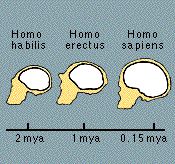
 Some evidence found in the cavities of Homo Habilis's brain suggests that the brain evolved in speech. This gave scientist the theory that small parts of speech evolved 2 and 1/2 million year ago.
As speech evolved over  the years the Larnyx also known as the voice box (it is what makes the sounds)for mammals started to descend down the throat and to diconnect from the nasal cavity. Before this change the Larnyx sat high in the throat and connects to the nasal cavities allowing us to breathe and swallow at the same time. After this change for the genus homo that lived 1 1/2 years ago changed the way they breathed, swallowed and made sounds. 

As many of you know we don't breath through  our nose as much as we breath through our mouth. Scientists believe that we changed from breathing through our nose to our mouth more because it helped us let more air in while chasing game and let us run longer distances. Ever wonder why or how our brains grew? Well scientist believe that what we eat/ our diets is what make brains grow. Of course not in a week but over a couple if years.

Our ancestors must have used some type communication, if they didn't how would they be able to tell each other that there are predators around, where they had to go during a journey and teaching each other  how to make things just like we do. Our ancestors possibly communicated with  language, speech and sign language. Sign language such as gestures. One thing that I found interesting is that maybe they didn't communicate at all with real languages (English), well just until later. Maybe they really didn't need language, they had big enough brains to see and copy things like a parrot. They could have just looked what others were doing to learn. We see people everyday wearing clothes that we don't have and things that we don't do, but we don't always have to talk to them to wear and do what they do we could just look at them.


Thursday, November 17, 2011

Taming Fire, The First Scientist?

Beth, Mary. "Taming Fire, The First Scientist?"  
Odyssey: Adventures In Science Oct. 2009: 29-30. 
Print. 
Prehistoric people, our ancestors,created our living styles we just changed a few things as our brains
 became larger.

Wildfires are a cause of animals and prehistoric peoples migration. Wild fires would force
 the animals to migrate or just get out of the way. But these fires did help the prehistoric people in one way.
 The animals that couldn't get out of the way in time burned which left a delicious but burnt meal for prehistoric people. 
Since fires are such a scare to prehistoric man you would never think that they would make and use fires them
 selves, not wild fires though.

Humans have used fire for 250,000 years, we would know this because scientist have found hearths or remains 
of hearths. This is evidence that prehistoric people used fire intentionally. Hearths are used to contain a fire, to stop it
 from spreading these are usually in stone shaped circles. 
The hearths are also evidence that the fires weren't wild fires because hearth fires allow artifacts like bones to be closely analyzed for chemical changes because of the higher temperatures. From the analysis from the chemicals in the bones we can get a few hints that the first use was by humans more than 1,000,000 years ago.
More evidence that we used fire in different ways was discovered in the Swartlands in South Africa. Remains of prehistoric animals bones that were burnt. 
This could suggest that they learn't to cook their meat. But it is also a possibility that they did not make the fire themselves. I came to the suggestion that maybe the prehistoric people didn't light a fire or cook the animal at the time they simply dragged the animal back to the cave from the wildfire.
But fire to our ancestors was very important fire could give them
  • Cooked food which make it taste better
  • Killed parasites
  • Kept them warm throughout cold weather
  • provided light 
  • Kept predators away
  • And lastly made migrating from cold to warm weathers possibly for prehistoric people

Tuesday, November 8, 2011

Have you ever wondered how we primates came to walk on 2 legs?

 Anthropologists are among the people that can answer
this controversial question on Human evolution.
 Primates such as chimps, are not our ancestors
but they do share an ancestor in common with us,Australopithecus Afarensis,
that lived six million years ago.

 Primates have a few things in common, and many differences most notably those involving our skulls. Our face is pretty flat while chimp's stick far out.  The biggest difference between Australopithecus Afarensis "Lucy", us and Chimps is the Foramen magnum, the hole at the back of the skull that the spinal cord fits into. Our Foramen magnum is at the bottom of our skull at the back, and our spinal cord fits in horizontally,  if we are standing up it would obviously be vertical. This is what allows us to walk on two feet. Similarly the Foramen Magnum of "Lucy" is also placed at the bottom of the skull and the spinal cord is horizontal. This similarity is evidence that "Lucy" walked bipedally like us. In contrast, the chimp's Foramen Magnum is "Angled backwards and downwards," suggesting that they walked on all fours.


The fact that bipedal creatures with roughly bigger brains than chimpanzees walked the earth only 2 million years ago, that were before humans ever evolved shocked scientist all over the world.

Many theories proposed why creatures preferred to walk biped ally. One argues that it is to free their hands to create stone tools. Interestingly stone tools only appeared in the fossil record after the creation of bipedal walking. C.Owen Lovejoy a scientist at Kent State University believes that we started walking bipedally so that our hands are free to get food for the other members of the group. Thus making a parent of young to give more attention to her children. I think this is a very reasonable theory but sadly scientist don't, they have rejected his theory because they believe that there is no specific evidence. Another belief is that we started walking bipedally to cross and swim streams or even seas.


Monday, October 31, 2011

Who's Who Among the Early Hominids?


Susman, Randall. 
"Who's Who Among the Early Hominids?"
Odyssey Adventures in 
Science Oct. 2009: 
22-25. Print. 
The records of early Hominins also known as the Ape Men and our 
ancestors date back to 7m.y.a and supports evidence of our close 
relationship with, and evolution from, the African ape.   
The fossil record of early hominids evolution show Primitive and Advanced. 
Primitive focuses on ape-like evolutions while Advanced focus on 
Human-Like evolutions. The definition of Hominins are members of a 
group of primates that includes modern humans and all of our ancestors. 
Homininds only refer to the living primates such as us.
Some examples of early hominins  
  • Sabelanthropus
  • Orrorin
  • Ardipithecus
They are hominins because they are dead now, if they are living they would be hominids.When we study fossils to classify what species they are in we are classifying the taxonomic. Taxonomic is having to do with the classifying of living things, so classifying go hominins.
When we are studying fossils of species we can lean about the positional behavior, 
meaning the way animals stand and move.
Also we can look at the wear patterns on the teeth and this will determine what the hominin ate. One of the most important parts is looking at the sexual dimorphism, this is looking at the difference of size and shape between males and females, it is important to when studying the fossil record to acknowledge if the fossil is of a male and female of the same species or of different species.
All of the early homos that lived in the past are the first members of our species. Most of the fossils of early homos were found in east and south Africa about 2 m.y.a.The period of the homos was an epoch period. Epoch is a period of time in history that is important/ noteworthy. 
The early homos such as
  • Homo Erectus (The Upright Man)
  • Homo Habillis (The well known Handy Man)
  • Homo Rudolfensis
These three to me are the most well known hominins of the Homo species. There are others such as the
  • Homo Georgicus
  • Homo Florensis
  • Homo Neanderthalensis

Thursday, October 27, 2011

Why We Study Human Origin


Susman, Randall.
"Why We Study Human Origins."
Callipoe Sept. 1999: 4-5. Print.

In the past people relied on religious teachings and myths to explain the beginning of humanity, they relied on Human origins.

People these days such as myself always have the curiosity of how life was like in the past. The questions that we tend to ask each other or our selves is Why did human come to be, and Why did Hominids survive, Where did we orginate? All the questions are part of the human origin. There is also another answer to all these questions known as the Fossil Record. “The Fossil record  can provide interesting information about the evolution and the history of life on earth such as the way the particular species have lived during a specific geological period and then evolved in time”. (http://www.biology-online.org/dictionary/Fossil_Record) Fossils can help us learn about how early our ancestors lived and how they adapted to their surroundings, they also give us a good idea of their physical features and behavior. 

Charles Darwin a scientist from the 1800 developed a ground breaking theory called Theory of Evolution by observing plants and animals. This theory is proposing that hominids  have descended from hominids like us. For example we have descended from the homosapians, this is what Charles Darwin is trying to say. "Evolution is a process that results in heritable changes in a population spread over many generations". (http://www.talkorigins.org/faqs/evolution-definition.html)
 
Henry Huxley a well known scientist had proposed that apes and humans anatomically more similar than apes and monkeys. In this sentence anatomically is referring to the anatomy of apes and humans compared against apes and monkeys. Interestingly enough during the time periods of Huxley and Darwin there were no fossils found of our ancestors therefor their theory's were not proven by any evidence. Later on during 1925 Raymond Dart dicovered the first fossils, they were first found in Africa. This had proved to historians that our ancestors were bipedal. This is the theory that we no know today, we were descendants of Homosaphiens and Homosaphiens are descendants of other hominids. It just keeps going for another 6 million year and maybe even more.


I last thing, I would love to share this funny advertisement by Ogilvy Pr about human evolution. 


Tuesday, October 18, 2011

Theories of Stonehenge

Stone henge is located in England, Wiltshire. Stone henge is made of tall standing rocks called Sarsen stones and smaller stones called blue stone. The large stones stand up right with either a smaller sarsen laying on top. The Sarsens are on the outside creating a full circle and the blue stones are inside the Sarsen circle creating a smaller blue stone circle.

                  This is a animated  Stonehenge       


This is what stone henge looks like 
today. As you can see some stones 
have been knocked down over the years.                                                                             


Now that you have an idea of what Stonehenge looks like I am going to tell you a few theories of why Stonehenge was built.

Mike Parker Pearson of the University of Sheffield has the theory that Stonehenge was built a sacred place for the dead while a different monument, Woodhenge, made of wooden pillars is a place for the living. He also believes that Stonehenge is a part of  bigger more complex monuments in the area.

A very different theory suggesting that Stonehenge was a place of healing. People visiting from far and wide believing that Stonehenge would cure them of their diseases. Many remains excavated from the ground show signs of people having injuries or illness. Some remains excavated were teeth and bones and when tested people found that these remains were of people from far away places such as Wales, Northern England and Ireland.

Amazingly one of the most popular theories is that is was created as an Astronomical Observatory used to mark mid-summer. Evidence shows that people visited in the summer but also during the winter solstice, when the sun sets between the largest of the central arches.

Others also suggest that Stonehenge was used to predict solar and lunar eclipses.

Lastly Stonehenge could have been used to demonstrate the movements of the moon. Lionel Syms of the University of East London proposed that the creation of Stonehenge marked a change in society, from hunting to agriculture. The change is similar to the change from lunar to solar worship. When observations of the sun and the moon were combined, our ancestors could have been trying to show that they were part of the same spiritual force. 

There is one specific theory that i found a bit wacky, was the UFO theory. People are convinced that they saw UFO'S and are positive that Stonehenge was a landing area for aliens.

Sunday, October 2, 2011

Human Ancestors May Put Twist in Origin Studies, New Studies Say

A New fascinating discovery is found!  Bones and possibly 2 million year old skin from our ancient ancestors the Australopithecus sediba  were discovered in the Malapa region of South Africa in 2008 and now described for the first time last april.

After scientists researched the sedibas anatomy they believe that sedibas could have been capable to make tools and use them. Also they may have found the fossilized skin which will mark the only discovery of soft tissue ever found. 

The people involved in this discovery is the study leader Lee Berger an anthropologist at the University of the Witwatersrand in Johannesburg, Scott Simpson a paleontologist at Case Western Reserve University in Cleveland, Ohio, and a team of researchers. 

The scientists have found that the fossilized skin and bones belong to a Male and Female Sediba both about 30 years old. Very interestingly the scientists also were able to discover that the pair died about at the same time. Possibly days or hours apart. 

This pair had fallen into a chasm ( a natural death trap) and rested upon a underground cave. This underground death trap had killed many more animals and were littered with tons of bones. Over time these bones were covered with a thick cement stone material also known as breccia that help preserve these bones just for the researchers to find.

After studying these bones the researchers were able to find that the Sediba had many human features. The Sediba was in fact able to stand up right much like a human. The ankles were very human like but the heels were more apelike.

One very interesting fact that i had read was that "With every heartbeat, the brain pounds out its shape on the developing skull of a child, eventually leaving a beautiful impression of the external shape and form of the brain on the inside of the skull," study co-author Kristian Carlson, also from the University of Witwatersrand, explained in a statement.